NOTE:
For optimal use turn phone 9T degrees into landscape mode.
Make sure you have this feature switched on on your mobile device.
ThxQ
————————————————————-

— AMPLIFIED BICYCLING /\ A NEW SPORT —
This website states initial guidelines for the development of
– an amplified bicycle
– riders attire
THE AMPLIFIED BICYCLE — MANIFESTO
This is an AMPLIFIED BICYCLE.
This is not an augmented bicycle.
This is not an electric bicycle.
This is not a vehicle.
This is AMPLIFIED BICYCLING.
The rider’s legs are the origin of speed.
Pedaling is visible, undeniable, and central.
Electric systems do not replace effort — they magnify it.
If the rider stops, speed fades.
If the rider suffers, it is visible.
If the rider wins, it is earned.
Technology is silent.
Effort is loud.
Strategy decides.
This is cycling — amplified!
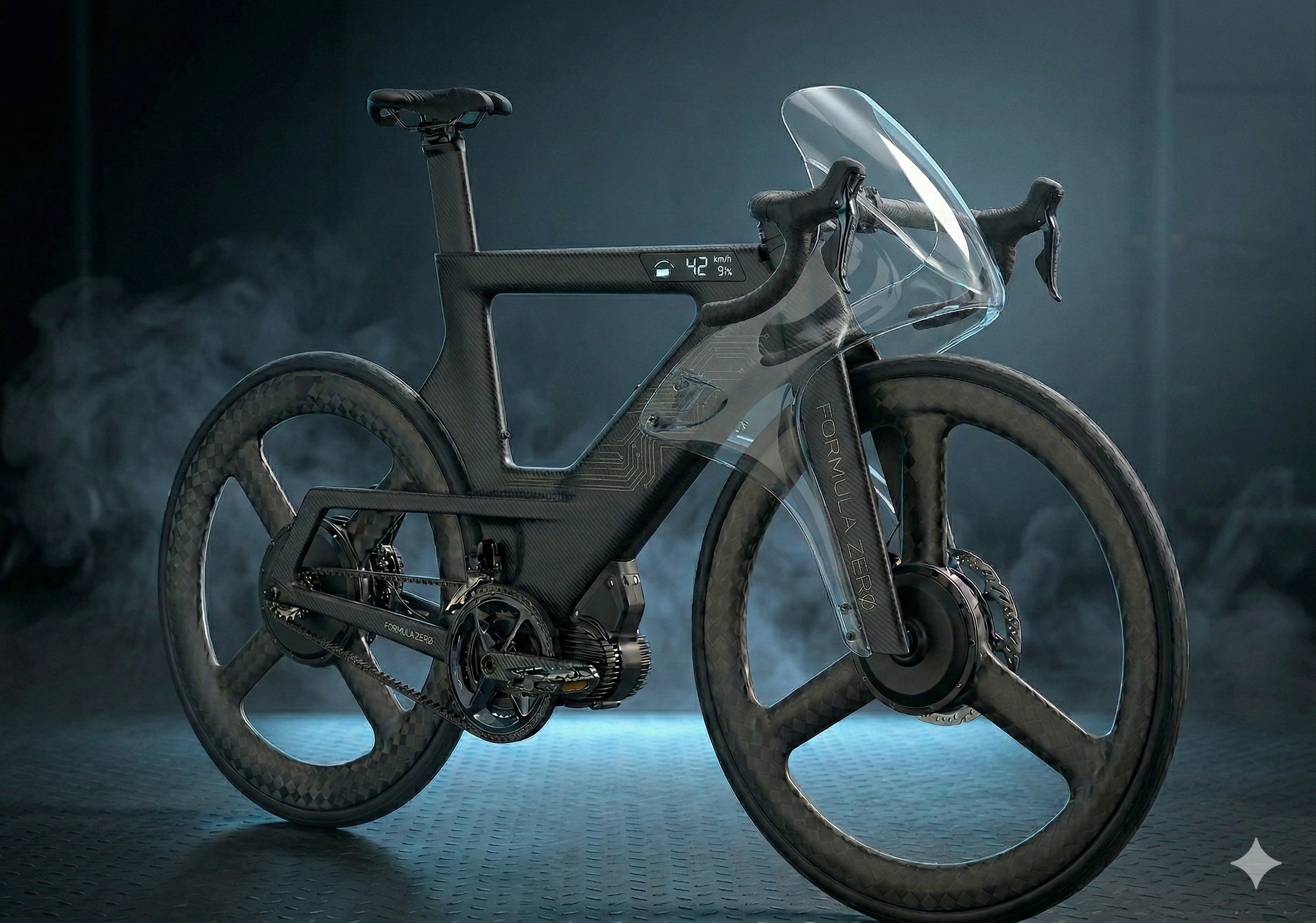
AMPLIFIED TRACK BICYCLE
Experimental Prototype – v0.13
Open Development Specification for Teams
These design specifications are open for interpretation. They serve as a guideline. Please challenge the proposed guideline in order to develop a safe and working product.
- Core Definition (Non‑Negotiable)
This prototype is an amplified bicycle.
Amplified means:
- Pedaling is the primary propulsion input
- Electric motors multiply rider effort
- Rider effort must be visible and believable
- The bicycle must look and behave like a bicycle
This is not an e‑bike, not a vehicle, not a motorcycle, however it can have features that are new to cycling in order to make it work and let it be safe, amplified bicycling.
- Visual & Form Requirements
The bicycle must be instantly recognizable as a bicycle.
Mandatory visual elements
- Diamond frame layout (open or closed)
- Visible crankset and chain/belt
- Visible pedaling motion
- Rider legs must remain visible at all times
- Traditional saddle‑based riding (no recumbent layouts)
Prohibited
- Fully enclosed leg structures
- Enclosed drivetrains
- Motorcycle‑derived components
- Geometry & Riding Position
Riding position
- Crossover of:
- Road race bicycle
- Beach racer
- Light TT influence
Allowed positional characteristics
- More forward‑seated position than conventional road bikes
- Emphasis on pushing backward through the stroke rather than purely down or forward
- Rider torso low for aero, but legs remain clearly visible
- Position must visually communicate effort at speed
Handlebar
- Flared race bar (mandatory)
- Wide drops for high‑speed stability
- Compact integrated aero cockpit allowed
- Electronic shifters integrated in levers
TT bars are not allowed.
- Frame, Structure & Energy Integration
Frame
- Carbon frame
- Diamond frame may be closed
- Closed sections may contain the main battery and electronics
- Rigid construction
Suspension
- No suspension allowed
- No front suspension
- No rear suspension
Rider protection (integrated)
- Portions of the frame may extend to deflect ground contact and absorb sliding energy
- Protective structures must:
- Not fully enclose the legs
- Preserve clear visibility of pedaling motion
- Maintain a bicycle silhouette
- Wheels, Tires & Brakes
Wheels
- Carbon bicycle wheels
- 29‑inch
- High‑strength rims designed for extreme speed
- Carbon spokes permitted
Tires
- 5–6 cm width; investigate optimal width.
- Slick or semi‑slick
- Need to function as suspension for the rigid-frame setup
Brakes
- (Hydraulic) Disc brakes (front and rear)
- High thermal capacity
- Energy‑harvesting braking systems permitted but not compulsory for the first setup
- Drivetrain & Shifting
Gearing
- Multi‑gear drivetrain
- Gearbox is part of the interface for amplification
- Gear range must support human‑believable cadence at high speed
- Electronic shifting is mandatory
- Pedal Input & Human Gating
Sensors (mandatory)
- Crank‑based torque sensing
- Cadence measurement
- Redundant pedal motion verification
Enforcement rules (normal amplified mode)
- Motor torque = 0 if pedal torque = 0
- Motor torque = 0 if cadence invalid
- No throttle
Pedaling remains:
- The visual narrative of propulsion
- The basis of amplification logic
- Motor Architecture (Exploratory)
Allowed
- Dual motor
- Triple motor
Motor placement may include variations of:
- Front hub
- Mid‑drive
- Rear hub
Constraints
- Total amplified output capped in software
- Motors obey a single rider‑derived intent signal
- Distribution logic is open for experimentation
- Power & Amplification Logic
Reference
- 45 km/h corresponds to 300 W rider reference
actual wattage at speed needs to be set in tests! - Initial amplified top speed (non‑boost): 150 km/h
!! This is a power truth reference, not a fixed speed limiter. Initial goal is to achieve +100km/h, second goal is to safely and steadily up speed to 150km/h.!!
Amplification zones
Initial indication:
- 0–20 km/h
Soft amplification
Controlled launch - 20–35 km/h
Main amplified riding zone
Clear effort‑to‑speed relationship - >35–45 km/h
High‑speed zone - >45 km/h
Excess rider‑authorized power is stopped from increasing speed and diverted to energy storage
Acceleration must feel progressive and controllable. Eventually the setup of the amplification zones need to be configurable. Each race a different setup is allowed, based on track and rider performance capabilities in corners and on the straights.
- Energy Banking & Boost System
Energy sources
- Excess rider‑authorized energy above 300 W will be stored for boost.
- Regenerative braking energy (if implemented)
Energy may be stored in:
- Batteries
- Supercapacitors
- Hybrid systems
Placement on the bike is specified, hence open for development. Mostly is the “triangle” between front and rear wheel.
Boost mode
- Activated by handlebar button
- Pedaling during boost is allowed but not mandatory
- Boost draws exclusively from stored energy
- Boost follows an exponential acceleration profile
- Maximum boost duration: 6 seconds
- Maximum attainable speed during boost: 170 km/h
Boost behavior depends on entry speed:
- Starting near 150 km/h → may approach 170 km/h rapidly and maintain it for remaining seconds.
- Starting at lower speeds → may not reach 170 km/h within 6 seconds
- Control System & Safety
Mandatory
- Physical kill switch
- Redundant sensor validation
- Fail‑safe motor shutdown
- Thermal and current protection
- Speed‑based torque limiting
- Telemetry, Data & Strategy
Collected data
- Rider power
- Cadence
- Speed
- Boost availability
- Energy storage level
- Acceleration profiles
Data availability
- All collected data is visible to all teams
- Real‑time and post‑race access
- What This Prototype Is NOT
- Not a finished competition bike
- Not optimized solely for maximum speed
- Not locked to a single motor configuration
- Closing Statement
This document defines the first amplified track bicycle.
As long as:
- The bike looks like a bicycle
- Legs visibly propel it
- Effort is legible
- Data is transparent
…teams are free to develop.
— Keep in mind, the rigid frame design has no suspension, therefore tire compound and behaviour are paramount for handling and rider comfort —
Strength, agility, and strategy decide the race, not the biggest budget!
RIDERS ATTIRE
The next section states guidelines for the development of a riders attire:
– Suit
– Helmet with integrated visor
– Gloves
– Shoes/Boots
Safety is the leading design narrative. Riders comfort in terms of flexibility, heat and sweat distribution are second, but off course of vital importance in order to make this sport work..
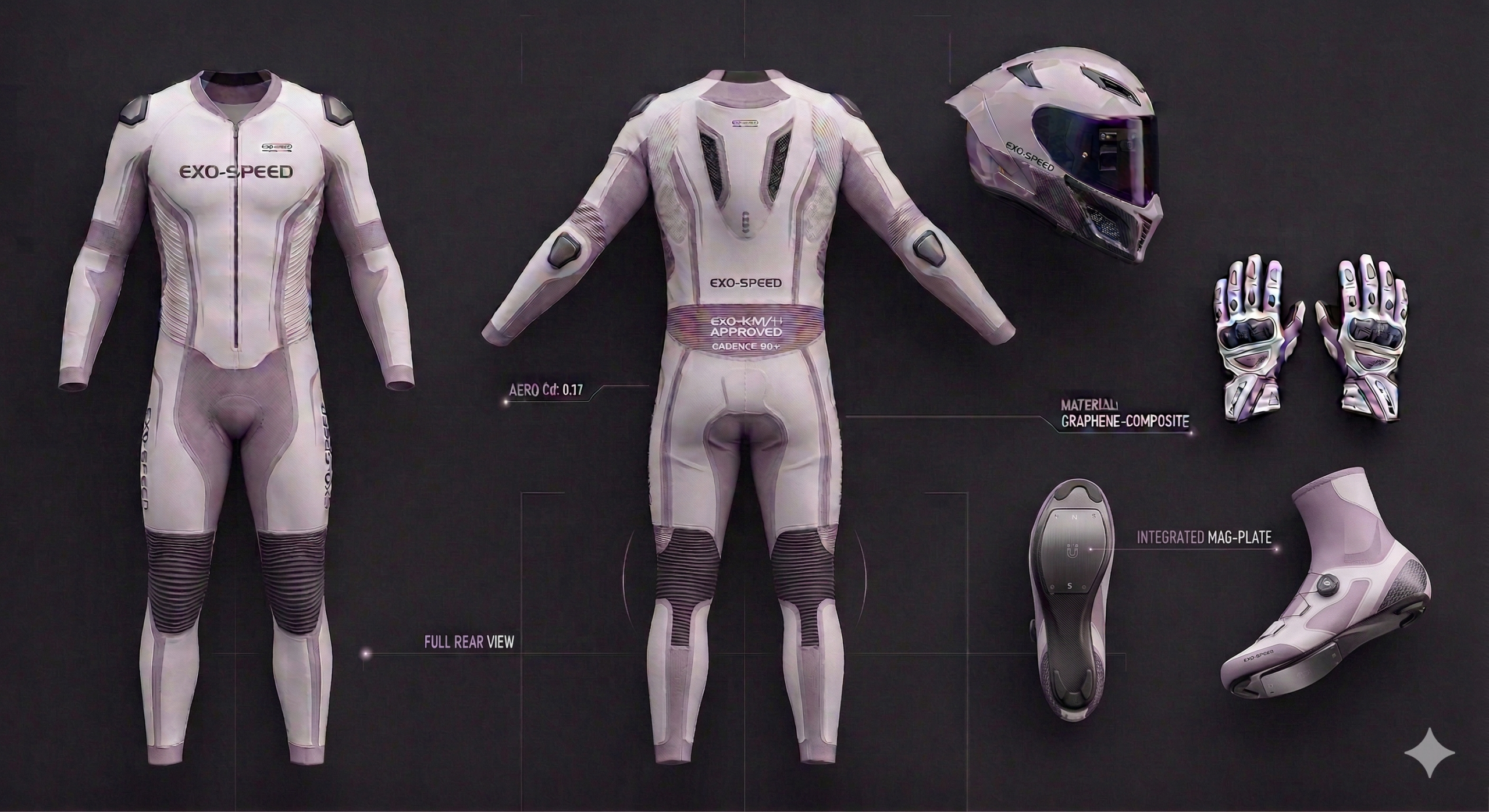
RIDERS ATTIRE GUIDELINES
- Kinematics & Biomechanical Freedom — The Mobility Rules
The suit must empower the athlete’s ability to act as the primary engine.
- Rule 1.1: Unrestricted High-Cadence Articulation
The suit and all integrated armor can allow for a continuous, fluid pedaling cadence of 80 to 120+ RPM without generating excessive resistance against the rider’s biomechanics. - Rule 1.2: Dimensional Frame Clearance
Protective elements can maintain a strictly low profile. The rider’s legs cannot widen to the point of striking the bicycle’s top tube or altering their natural pedal stance (Q-factor). - Rule 1.3: Ergonomic Posture Adaptation
The suit can be optimized for the aggressive, forward-leaning posture of a road cyclist, preventing fabric bunching at the waist or restricted breathing.
- High-Velocity Survivability — The Safety Rules
The suit must protect the rider from the physics of a 150 km/h motorcycle-level crash.
- Rule 2.1: Extreme Abrasion Resistance
The outer boundary of the suit can be proven to survive a continuous, high-friction slide on asphalt initiated at 150 km/h. - Rule 2.2: Dynamic Impact Attenuation
The suit can feature impact-absorbing zones at all major skeletal protrusion points to dissipate blunt-force trauma.
⚠️ THE ARMOR VS. CADENCE CONTRADICTION (Rules 2.2 vs. 1.1)
Soft or hard armor possesses physical thickness and resistance. Forcing a joint to bend against a thick impact pad 100 times a minute for an hour will exhaust the rider and cause severe chafing. Teams must invent armor that “floats” during pedaling but locks instantly during an impact.
- Rule 2.3: Joint Stabilization & Torsion Defense
The suit can incorporate an integrated structural system (like an exoskeleton) that protects the knees and ankles.
⚠️ THE EXOSKELETON VS. Q-FACTOR CONTRADICTION (Rules 2.3 vs. 1.2)
You cannot easily wrap structural, crash-rated bracing around a human knee without adding significant width. Adding width means the rider’s knees will smash into the bike frame, or they will be forced to pedal bow-legged, destroying their power output.
- Aerodynamics & Thermodynamics — The Efficiency Rules
The suit must manage the dual extremes of high metabolic heat and massive wind drag.
- Rule 3.1: Cohesive Aerodynamic Profiling
The entire system can integrate smoothly to minimize aerodynamic drag, smoothing turbulent air coming off the rider’s body. - Rule 3.2: High-Speed Thermal Extraction
The suit can incorporate an active or passive ventilation system to extract the 400+ watts of body heat the rider generates.
⚠️ THE COOLING VS. DRAG CONTRADICTION (Rules 3.2 vs. 3.1)
To cool the rider, you must open vents and scoop air in. But taking air into a suit acts like a parachute, destroying aerodynamic efficiency. Conversely, sealing the suit to make it perfectly aerodynamic turns the interior into an oven.
- Extremity & Cranial Integration — The Contact Point Rules
Hands, feet, and head can feature highly specialized interfaces.
- Rule 4.1: Forward-Biased Cranial Protection
The helmet can meet high-speed motorcycle impact standards (FIM/ECE) but can be exceptionally lightweight to prevent neck fatigue in a cycling posture.
⚠️ THE HOMOLOGATION VS. POSTURE CONTRADICTION (Rule 4.1)
Motorcycle helmets require thick, heavy foam and heavy visors to survive 150 km/h impacts. A 1.3 kg motorcycle helmet held horizontally by a cyclist’s neck muscles will cause debilitating pain within minutes. Teams must figure out how to provide motorcycle-level impact shielding at bicycle-helmet weights, or redesign how a helmet is supported.
- Rule 4.2: High-Velocity Optics
The helmet can feature a shatter-proof, anti-fogging visor capable of deflecting road debris at 150 km/h. - Rule 4.3: Low-Friction Tactile Gloves
Gloves can provide fine bicycle control while featuring low-friction slide zones on the palms. - Rule 4.4: Armored Power-Transfer Footwear
Footwear can have an ultra-rigid clipless sole while extending to protect the ankle bones and integrating with the leg-brace.
- Respiratory Dynamics & Thoracic Freedom — The Breathing Rules
The system must actively manage extreme high-speed airflow to support maximum cardiovascular exertion.
- Rule 5.1: Ram-Air Mitigation & Regulated Intake
The helmet’s front intake can diffuse high-pressure 150 km/h air so the rider can easily exhale against the incoming wind while still getting massive volumes of oxygen. - Rule 5.2: Active CO2 and Moisture Scavenging
The helmet can utilize the external aerodynamics to create low-pressure zones that actively vacuum exhaled CO2 and moisture out of the helmet. - Rule 5.3: Unrestricted Thoracic Expansion
The armor and layers over the ribcage can possess dynamic elasticity so the rider doesn’t expend pedaling energy just to expand their lungs.
- Microclimate & Moisture Transport — The Sweat Rules
The suit must actively manage the rider’s fluid loss, preventing both thermal overload and high-velocity wind chill.
- Rule 6.1: Directional Moisture Wicking
The primary layer can pull sweat away from the skin to maintain a dry friction interface, preventing severe chafing. - Rule 6.2: Controlled Evaporative Cooling
The suit can use external airflow to evaporate sweat without letting high-speed wind blast directly onto damp inner layers.
⚠️ THE FLASH-FREEZE VS. BOIL THERMODYNAMIC PARADOX (Rules 6.2 vs. 3.2)
If a team vents the suit too much, the 150 km/h wind hitting the rider’s sweat-soaked base layer will cause such rapid evaporative cooling that the rider will go into hypothermia, even on a warm day. If they seal the suit to block the wind chill, the trapped sweat boils the rider alive in their own body heat.
- Rule 6.3: High-Cadence Friction Mitigation: High-movement areas can feature zero-friction textiles to prevent sweat and rapid pedaling from causing severe skin abrasion.